Last updated: August 21, 2026
Most feeders sold for backyard birds are built around a bird the size of a chickadee. A Blue Jay is several times that, arrives with a shout, lands hard, and either cannot get a grip on the perch or swings the whole feeder sideways trying. People who want jays in the yard usually discover that their existing setup is the reason the jays only ever work the ground underneath it.
Feeding jays deliberately is a straightforward job once you accept the shape they need: a flat, stable surface on something solid, stocked with food big enough to be worth the trip. This guide covers what a Blue Jay feeder has to get right, which styles do it, and how to run one without handing the whole yard over to a family of jays.
This article contains affiliate links. If you buy through them, we may earn a commission at no extra cost to you. Learn more.
Quick Answer
What kind of feeder do Blue Jays use?
- A tray or platform feeder, or a hopper, mounted on a post rather than swinging from a hook.
- A landing surface wide enough for a bird to stand on with its tail clear.
- Food worth carrying off: peanuts in the shell, sunflower seed and suet.
- Drainage in the tray, because jays feed in the open and open trays collect rain.
Bottom line: put a covered platform or a large hopper on a pole, stock it with peanuts and sunflower, and keep the small bird feeders on separate hooks.
What a Blue Jay Feeder Needs to Get Right
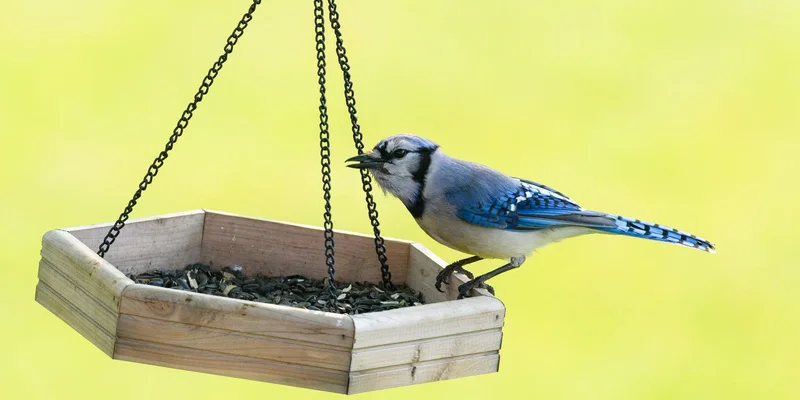
Stability and surface area, in that order. Cornell’s All About Birds account for the Blue Jay is unusually direct about it: jays prefer tray feeders or hopper feeders on a post rather than hanging feeders, and they prefer peanuts, sunflower seeds and suet. Those two sentences describe almost the entire buying decision.
The reason is body mechanics. A jay is a heavy, long tailed bird that lands rather than clings, and a feeder that swings under the impact throws it off before it has settled. A post mounted platform absorbs the arrival, gives the tail somewhere to go, and lets the bird turn around, which is what it wants to do while it decides which peanut to take.
Why They Take So Much and Leave
Jays cache food. Project FeederWatch, the Cornell Lab’s winter feeder survey, notes that larger birds such as jays may grab several peanuts at a time and fly off to hide them for later. What looks like a feeder being stripped is usually one bird making repeated trips to a stash, which is worth knowing before you conclude something is wrong with the setup.
What to Put in It
Peanuts first, sunflower second, suet third. That ordering comes straight from the Cornell Lab’s backyard tips for the species, and it holds up in practice. Peanuts in the shell are the item that turns an occasional jay into a daily one, because they are large enough to be worth caching and easy to carry.
Keep the peanuts plain. Salted, roasted, flavored or candied nuts are human food, and the sensible line for any wild bird is unsalted and unprocessed. Our piece on what not to feed birds covers where that line sits for the rest of the kitchen.
Sunflower and Suet as the Backup
Black oil sunflower is on the Project FeederWatch list as the seed a wide range of feeder birds take, jays included, and it has the advantage of feeding everything else in the yard at the same time. Suet brings jays in during cold months, though an open suet cage will also bring starlings, which is a trade you make knowingly.
Blue Jay Feeders by Situation
Best All Around: A Covered Platform on a Post
The default answer is a platform feeder with a roof, mounted on a pole in the open. The roof keeps rain off the peanuts, the pole keeps the surface still, and the open sides let a jay land facing any direction. This is the setup that matches Cornell’s description most closely.

When You Want One Feeder to Serve Everything
A large hopper on a post feeds jays and most other feeder birds from the same box. Project FeederWatch notes that large hoppers attract most species of feeder birds and allow larger species to feed, which is exactly the behavior you want when jays are on the guest list rather than the problem list.

The Peanut Feeder That Makes Them Regulars
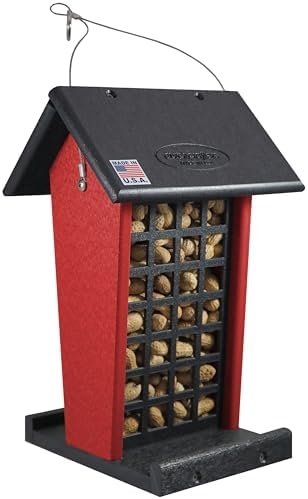
A dedicated whole peanut feeder, usually a wire cylinder or a mesh basket, holds peanuts in the shell where a jay can work one loose. It is the single most effective way to get jays visiting on a schedule, and it keeps the shells in one place instead of scattered across the seed tray.
A Ground Level Option for a Yard With No Pole
Jays are comfortable feeding low. An open ground tray on short legs gives them a stable surface without a post, and it suits a yard where you cannot sink a pole. Keep it away from dense cover so the birds can see what is coming, and bring in what is left before dark.

Suet for the Cold Months
A suet cage with a tail prop board gives a jay something to brace against, which most cages do not. It doubles as the woodpecker station, so it earns its hook twice over. More on the shapes in our suet feeder guide.

Comparing the Options
Three things separate these feeders in practice: how stable they are, whether the food stays dry, and how much of the rest of the yard they also feed. Here is the short version.
| Feeder | Stability for a big bird | Weather protection | Best suited to |
|---|---|---|---|
| Covered platform on a post | Best, nothing swings | Roof over the tray | The default jay feeder |
| Large hopper on a post | Very good | Seed stays in the box | Feeding jays and everyone else |
| Whole peanut feeder | Good, birds cling and pull | None, so refill small | Making jays into regulars |
| Ground tray | Good, but exposed | None, needs draining | Yards with no pole |
Keeping Jays From Taking Over the Whole Yard
Separate the stations. A jay feeder on a pole in the open and a small bird feeder on a different hook near cover will run in parallel without much conflict, because the two groups want different positions in the yard anyway. Trying to serve both from one feeder is what produces the standoff.
If jays are emptying the feeders meant for chickadees and finches, the answer is exclusion by design rather than by chasing. Project FeederWatch notes that tube feeders with short perches accommodate small birds such as finches while excluding larger birds such as grackles and jays, and that a small hopper prevents larger species from perching comfortably.
The Caged Option
A wire cage around a tube feeder is the blunt version of the same idea, and it works. We cover the grid sizing and what it does to the rest of your visitors in keeping big birds off a feeder and in the small birds only guide.
Setup Mistakes That Cost You the Birds
The first is hanging the feeder. A swinging feeder is a poor landing pad for a heavy bird, and jays will simply use the ground under it instead, which is why so many people conclude their jays refuse feeders. Move the same feeder to a pole and the behavior usually changes within days.
The second is buying too small. A tray sized for finches gives a jay nowhere to put its tail, and a hopper with narrow perches offers nothing to stand on. Surface area is the specification that matters, and it is the one most listings bury under everything else.
Frequently Asked Questions
What is the best bird feeder for Blue Jays? A covered platform or a large hopper mounted on a post. Cornell’s All About Birds account says jays prefer tray or hopper feeders on a post over hanging feeders, and that matches what people see in their yards.
What food attracts Blue Jays fastest? Peanuts in the shell, unsalted. Cornell lists peanuts, sunflower seeds and suet as the foods jays prefer, and peanuts are the one that gets them coming back on a schedule because they can carry and cache them.
Will a Blue Jay use a tube feeder? Rarely, and not well. Tube feeders with short perches are designed around small birds, and Project FeederWatch describes that design as one that excludes larger birds such as grackles and jays. That is useful if you want it, frustrating if you do not.
How do I stop jays emptying my other feeders? Give them their own station and make the others harder to use. A caged tube or a small hopper with short perches lets small birds through and keeps big ones off, which is exclusion rather than deterrence.
Why do jays take so many peanuts at once? They cache them. Project FeederWatch notes that jays may grab several peanuts at a time and fly off to hide them, so a feeder emptying quickly is usually one or two birds stocking up rather than a flock.
Do Blue Jays scare other birds away? They dominate a feeder while they are on it, but most yards settle into a rotation. Spacing feeders apart and keeping a small bird station near cover reduces the standoffs more than anything you can do at the feeder itself.
The Bottom Line
Blue Jays are easy to feed once the feeder stops moving. Put a covered platform or a large hopper on a pole, stock it with unsalted peanuts and black oil sunflower, and keep the small bird feeders on their own hooks near cover. That single change, from hanging to post mounted, does more than any brand decision. If you want the food side in more depth, see what to feed Blue Jays, and if you are choosing between feeder shapes for a mixed yard, hopper, tube or platform compares them side by side.