Last updated: August 21, 2026
Blue Jays split the backyard into two camps. One half of the street loves them, because a jay is a big, loud, genuinely handsome bird with a personality you can watch from the kitchen. The other half wants them gone, because five jays can strip a tray feeder in ten minutes and the chickadees give up and wait in the hedge.
Both camps usually want the same thing in the end: jays in the yard without the jays eating everything. That turns out to be mostly a question of what you offer and where you put it, because jays and small birds want different foods in different places. This guide covers what the sources say jays eat and how to keep the small birds fed at the same time.
This article contains affiliate links. If you buy through them, we may earn a commission at no extra cost to you. Learn more.
Quick Answer
What do Blue Jays eat at a feeder?
- Peanuts, sunflower seeds and suet. That is the Cornell Lab summary of Blue Jay feeder preferences.
- They prefer tray or hopper feeders on a post over hanging feeders, also per Cornell.
- Cornell’s Project FeederWatch seed preference testing put jays with black oil sunflower, shelled sunflower, suet and peanuts.
- Offer peanuts at a separate station away from the main feeder and the small birds keep their seed.
Bottom line: give jays their own tray of peanuts somewhere else in the yard, and put short perches on the feeder you want small birds to use.
What Blue Jays Actually Take
The Cornell Lab species account is short and clear: Blue Jays prefer tray feeders or hopper feeders on a post rather than hanging feeders, and they prefer peanuts, sunflower seeds and suet. Cornell’s Project FeederWatch seed preference work put jays with black oil sunflower, shelled sunflower, suet and peanuts, which is the same list from a different angle.
Away from feeders, jays are famous for acorns. Cornell credits their fondness for acorns with helping spread oak trees after the last glacial period, which is a useful thing to remember in October when the jays that emptied your tray all summer suddenly vanish into the oaks for a month.
Peanuts, and Why They Vanish So Fast
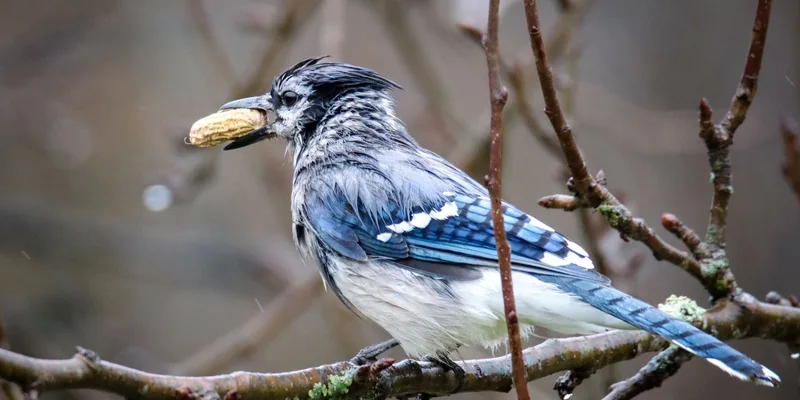
Peanuts in the shell are the single most effective jay food, and they are also the reason people think jays are eating them out of house and home. Cornell notes that larger birds like jays may grab several peanuts at a time and fly off to hide them for later, so a tray does not get eaten so much as it gets carried away.
Cornell’s own feeder cam observations describe the routine: a jay flies into the tray, carefully selects a peanut in the shell, tries to fit it in its throat pouch, picks up another if that worked, then flies off and comes back for more. Ten peanuts can disappear in two minutes and almost none of them have been eaten yet.
Use That Behavior Instead of Fighting It
Because jays cache rather than sit and feed, a peanut station is self limiting in a way a seed feeder is not. Put a handful of in shell peanuts on a tray or a platform at the far end of the yard in the morning. The jays clear it, take the food away, and then largely leave the sunflower feeder alone for the rest of the day.
Keeping the Small Birds Fed
The exclusion tool is perch length, not food. Project FeederWatch is explicit that feeders with short perches accommodate small birds such as finches but exclude larger birds such as grackles and jays. A tube feeder with short pegs and no tray is a feeder a jay cannot use comfortably, and it will move on to something easier.
Cages take that further. A wire cage around a tube lets chickadees, titmice and finches through the grid while keeping jays outside it, which is covered in our caged feeder guide and in feeders only small birds can get into. Neither one harms a jay. It simply cannot reach, so it goes and eats the peanuts instead.
Foods and How Jays Handle Them
The food column follows the Cornell Lab and Project FeederWatch descriptions of Blue Jay feeder preferences. The last column is what it means for the rest of your feeder birds.
| Food | How jays take it | Best offered on | Effect on small birds |
|---|---|---|---|
| Peanuts in the shell | Selected and carried off to cache | Separate tray or platform | Draws jays away from the seed feeder |
| Black oil sunflower | Taken readily at a tray or hopper | Hopper on a post | Competes directly at the main feeder |
| Shelled sunflower | Easy pickings, disappears fastest | Covered tray, kept dry | Emptied before small birds get a turn |
| Suet | Worked at from a cage or a tray | Bottom access suet cage | Bottom access cages favor clingers |
| Safflower | Largely left alone | Hopper or tray | Cardinals keep eating, jays lose interest |
The Feeder Shape Jays Want
Cornell’s preference for tray and hopper feeders on a post over hanging feeders is worth taking literally. A jay is heavy and it does not like a feeder that swings under it, so a platform on a pole, a wide hopper roof or a flat tray is where you will see them settle and feed rather than snatch and run.
That gives you a design lever. If you want jays, put a platform on a post and stock it with peanuts and sunflower. If you would rather not have them at the main station, hang that feeder from a hook so it moves, keep the perches short, and skip the tray underneath. Our Blue Jay feeder guide covers the platform sizes and roof clearances that work for a bird that big.
Living With a Loud Neighbor
Jays are native birds, and the goal in the yard is distribution rather than removal. Everything worth doing is a matter of where the food sits and what shape it sits in: separate stations, short perches, cages around the seed you want small birds to have, and safflower in the hopper if the jays are dominating it.
The jay alarm call is the other thing people notice. Jays are quick to mob a cat or a hawk and the whole yard empties when they do, which looks like the jays chasing everything off. Give it ten minutes. If a hawk is genuinely hunting your feeder for a stretch of days, the usual advice is to take the feeders down for a week or so and let the yard reset, which we cover in keeping bigger birds off the feeder.
Frequently Asked Questions
What is the best food for Blue Jays? Peanuts in the shell, with sunflower seed and suet close behind. Cornell lists peanuts, sunflower seeds and suet as Blue Jay feeder preferences, and peanuts are the food that pulls them to a station of their own.
How do I stop jays from emptying my feeder? Short perches and cages. Project FeederWatch notes that feeders with short perches accommodate small birds but exclude larger birds such as grackles and jays. Offering peanuts elsewhere in the yard does the rest.
Do Blue Jays eat other birds’ eggs? It happens, and it is a well known part of jay behavior, but studies of jay diets find it is a small part of what they eat. A yard with dense cover and nest boxes with proper hole sizes is the practical answer rather than trying to remove jays.
Will jays eat safflower? Mostly not, which is why safflower gets recommended when blackbirds and jays are dominating a hopper. Cornell describes safflower as a cardinal favorite with a thick shell that is harder for some other birds to open.
Why do jays carry off food without eating it? They cache it. Cornell describes jays selecting several peanuts, fitting them in the throat pouch and flying off to hide them for later, which is why a tray empties far faster than the birds could possibly be eating.
Do jays use hanging feeders at all? Some do, awkwardly. Cornell’s account is that they prefer tray or hopper feeders on a post rather than hanging ones, so a swinging tube with short perches is the least attractive setup you can offer them.
The Bottom Line
Blue Jays want peanuts, sunflower and suet on a flat surface that does not swing. Give them a peanut tray of their own at a distance, run short perches or a cage on the feeder you want chickadees and finches to use, and switch a dominated hopper to safflower. Nothing here removes a jay from the yard, it just moves the queue. Read next: our Blue Jay feeder guide for platform sizes, and which seed brings which bird for the wider seed picture.