Last updated: August 21, 2026
Almost nobody buys their second hummingbird feeder for the same reason they bought their first. The first one gets picked because it looks nice hanging from the porch. The second one gets picked because the first one dripped down the railing, filled with ants inside a week, and could not be scrubbed properly without a bottle brush thin enough to reach the neck.
That is the useful way to shop. Not by capacity, but by the four things that decide whether the feeder is still hanging in August: how it comes apart, whether it drips, what stops the ants, and whether the ports sit where insects cannot reach the nectar.
This article contains affiliate links. If you buy through them, we may earn a commission at no extra cost to you. Learn more.
Quick Answer
What should you look for in a hummingbird feeder?
- A feeder that comes fully apart, because you will be washing it far more often than you expect.
- Saucer construction if drips and insects are your problem, inverted bottle if you want capacity and a clear view of the level.
- A built in ant moat, or a hanger with room to add one, since ants find nectar within days.
- Ports set above the nectar line, which is what keeps bees and wasps out without a single spray.
Bottom line: pick the one you will actually keep clean, then worry about how it looks on the hook.
What Separates One Hummingbird Feeder From Another
Four things, and price is not one of them. How the reservoir seals and whether it drips, whether the whole unit disassembles for scrubbing, whether ants and bees can reach the nectar, and how the thing hangs or mounts. Everything else, including capacity and decoration, is preference you can indulge after those four are settled.
The reason those four dominate is that hummingbird feeders fail in the yard, not in the box. A feeder that seemed fine in April becomes a sticky, ant covered, half fermented nuisance by the first hot stretch of July, and every one of those problems traces back to one of the four.
The Two Basic Designs
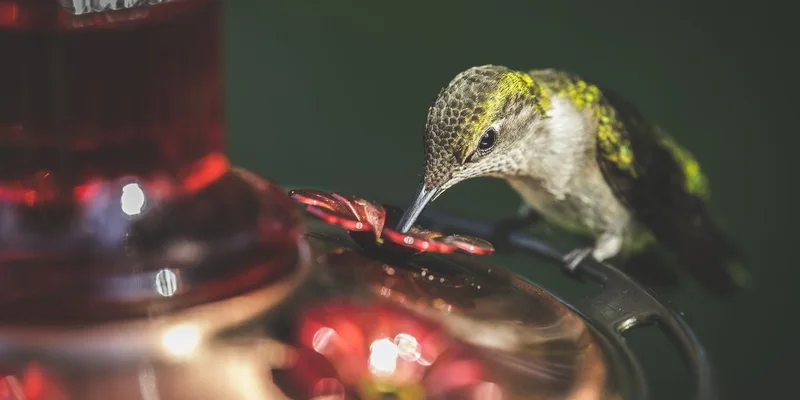
Hummingbird feeders come in two shapes. The inverted bottle holds nectar in a reservoir above the feeding base and lets a partial vacuum hold it in place. The saucer, sometimes called a dish or basin feeder, holds nectar in a shallow tray with the ports on the lid above the liquid. Both work. They fail differently.
The inverted bottle is the classic look and it shows you the nectar level from across the yard. Its weakness is that heat expands the air in the reservoir and pushes nectar out through the ports, which is where the drip on the railing comes from. A saucer has nothing to push, so it stays put, and the trade is a smaller capacity and no visible level from a distance.
Which One People Keep
Ask around and the pattern is consistent: people who fight ants, bees and drips end up on saucers, and people who want capacity and the look of a glass bottle stay on bottles and manage the drip by hanging the feeder in shade. Neither camp is wrong. We compare the two head to head in saucer or inverted bottle.
Ports, Perches and What They Change
A port is the hole the bird feeds through. Its depth is the single most useful spec on the whole feeder, because a port that sits well above the nectar puts the liquid out of reach of short tongued insects while a hummingbird bill reaches it without effort. Port count decides how many birds can feed at once, which matters less than you would think.
Perches are the other point of debate. Some feeders have none, on the theory that hovering birds feed and leave, and some have a full ring so the birds sit down. Sitting birds drink longer and are easier to watch, which is most of the point of hanging the thing outside a window in the first place.
Port Count Versus Territory
A six port feeder does not mean six hummingbirds. In most yards a single bird claims the feeder and chases the others off, which is why spreading two small feeders around a corner of the house usually shows you more birds than one large feeder does. That is covered in how many feeders you actually need.
Hummingbird Feeders by Situation
Best Starting Point for a First Feeder
A mid size saucer feeder with a built in ant moat covers the two problems beginners hit first, drips and ants, and it comes apart in three pieces for washing. It holds less than a tall bottle, which is a feature rather than a limitation while you are still learning how fast your birds drink.

When You Want the Classic Glass Look
Glass bottle feeders hold their color, do not cloud in sun the way some plastics do, and the reservoir stays visibly clean or visibly dirty, which is a useful nudge. Hang it where it gets morning sun and afternoon shade to keep the thermal drip down.

For a Balcony, a Rail or a Window
With no tree to hang from, the feeder has to attach to something. Window mounted feeders on suction cups and small clamp mounted feeders on a deck rail both work, and both put the birds close enough that you can see the throat color. Details in our window feeder guide.

If Cleaning Is Where You Give Up
Some feeders unscrew into a flat dish and a lid with nothing hidden. Others have a narrow neck, a fixed reservoir insert and a decorative collar that traps nectar out of reach of any brush. Buy the first kind. Our guide to feeders that actually come apart covers what to look for.

Comparing the Main Types
Capacity below is described in relative terms, since the same design is sold in several sizes and the useful comparison is behavior rather than volume.
| Type | Drip behavior | Cleaning | Best suited to |
|---|---|---|---|
| Saucer, top opening | Very little, nothing pushes nectar out | Easiest, opens into a flat dish | Hot yards, ant and bee trouble |
| Inverted glass bottle | Drips when the reservoir heats up | Needs a bottle brush for the neck | Capacity and a visible nectar level |
| Inverted plastic bottle | Same as glass, lighter to handle | Easy, but can cloud with age | Windy spots and larger volumes |
| Window mounted dish | Minimal, usually a shallow tray | Simple, but you reach across glass | Balconies, apartments, close viewing |
Ants, Bees and the Rest of the Insect Problem
Insects arrive at a hummingbird feeder within days, and the fix is mechanical rather than chemical. Ants are stopped by a moat, a small cup of plain water in the hanging line that they will not cross. Bees and wasps are stopped by port geometry, which means nectar sitting below the reach of a short insect tongue.
Nothing sprayed, smeared or dusted belongs anywhere near a feeder. Oils and petroleum jelly on the hanger foul the feathers of any bird that brushes them, and insecticides have no place around something birds drink from. Our articles on built in ant moats and port depth against bees cover the hardware that does the job.
Cleaning, and Why It Decides Everything
Sugar water spoils, and warm sugar water spoils fast. The Cornell Lab of Ornithology recommends cleaning hummingbird feeders at least once a week with hot water and a bottle brush, without soap or detergent, and changing nectar more often in hot weather. Any feeder you cannot open and reach into will lose that argument.
This is the real reason to hold a feeder in your hands before you commit to it. Count the pieces, look for a corner a brush cannot reach, and check whether the base separates from the reservoir without a fight. Everything else about the feeder is style. For the mix itself, see our nectar recipe guide.
Common Mistakes When Buying
The biggest one is buying on capacity. A large reservoir sounds efficient until you realize the nectar has to be dumped and replaced long before the birds empty it, so you are throwing away most of what you mixed. Small and frequently refilled beats large and half fermented every time.
The second is buying a feeder with a lot of yellow on it, since yellow accents draw wasp attention that red ones do not. The third is buying something with decorative glass detail around the ports that looks lovely and cannot be scrubbed. Pretty is fine. Pretty and sealed shut is not.
Frequently Asked Questions
What is the best hummingbird feeder for beginners? A mid size saucer with a built in ant moat and a lid that lifts straight off. It handles the two problems that put people off feeding hummingbirds, drips and ants, and it washes in under a minute.
How big should a hummingbird feeder be? Smaller than most people buy. Since nectar has to be replaced regularly whether or not the birds finish it, size the feeder to what your yard drinks in a couple of days rather than to what looks generous on the hook.
Do hummingbird feeders need perches? No, but perched birds feed longer and are much easier to watch. If the point of the feeder is looking at hummingbirds rather than just supporting them, get one with a perch. See our guide to perched feeders.
Does the feeder have to be red? The feeder itself, yes, in the sense that red hardware is what draws birds in. The nectar does not need coloring. Audubon says red food coloring is not necessary and could prove harmful to birds.
Glass or plastic? Glass keeps its clarity and color longer, plastic survives being dropped and is lighter on a suction cup or a thin stake. We break the choice down in glass or plastic hummingbird feeders.
Where should the feeder hang? In partial shade, within sight of a window, with some cover such as a shrub or a low branch nearby for the birds to perch on between visits. Full afternoon sun is what turns nectar and pushes drips out of a bottle feeder.
The Bottom Line
Buy the hummingbird feeder you will keep clean. That usually means a saucer with a built in moat and a lid that comes off in one motion, or a glass bottle hung in shade if you want the classic look and the visible nectar level. Skip the giant reservoirs, skip the yellow accents, and skip anything with a decorative collar a brush cannot get behind. Read next: our saucer feeder guide and feeders with an ant moat built in.