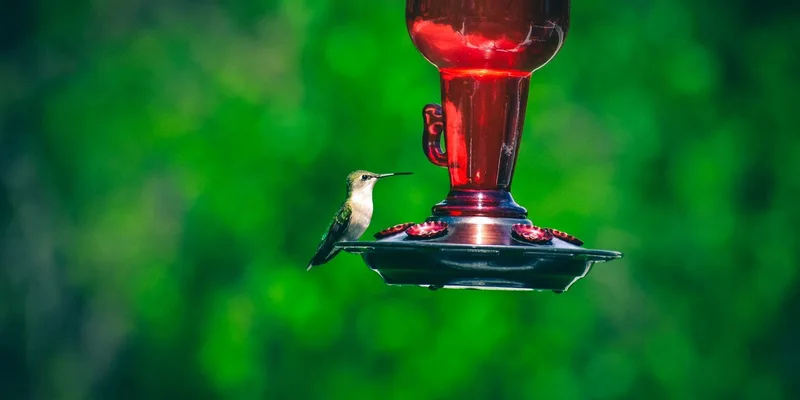
Last updated: August 21, 2026
Every hummingbird feeder on the shelf is one of two things. Either the nectar hangs above the ports in a reservoir held up by a partial vacuum, which is the inverted bottle, or it sits in a shallow tray with the ports above it, which is the saucer. The rest is styling.
The choice between them comes down to one question you can answer before you buy: are you more bothered by a sticky porch post and insects at the ports, or by refilling more often and not being able to see the nectar level from the window? This comparison lays out where each design wins and where each one genuinely annoys people.
This article contains affiliate links. If you buy through them, we may earn a commission at no extra cost to you. Learn more.
Quick Answer
Saucer or inverted bottle: which leaks less?
- Saucer, clearly. There is no vacuum in the system, so nothing pushes nectar out when the sun heats the feeder.
- Bottle feeders drip because trapped air above the nectar expands through the afternoon and forces liquid through the ports.
- Saucers also keep insects off the nectar, since the liquid sits below the port openings.
- Bottles win on capacity and on showing you the nectar level from across the yard.
Bottom line: buy the saucer if the yard gets hot, buy the bottle if you want capacity and the classic look.
What Stands Against What
An inverted bottle stores nectar above the feeding base and relies on a partial vacuum to hold it there. A saucer stores it in a shallow basin with the ports in the lid. Everything that follows, drips, insects, capacity, cleaning and the visible level, comes directly from that one structural difference.
Neither design is new and neither is going away. Bottle feeders sell on appearance and volume, saucers sell on the practical problems that show up in month two.
Why Bottle Feeders Drip
It is physics rather than a manufacturing fault. Air trapped above the nectar in the reservoir expands as the feeder warms through the day and pushes down on the liquid, which escapes through the only openings available. Afternoon sun on a full feeder is the classic recipe for a wet base and a sticky post.
You can reduce it. Hanging in shade, filling the reservoir completely so there is less air to expand, and checking that the base gasket seats properly all cut the drip. What you cannot do is remove the mechanism, because the mechanism is the design.
What the Drip Costs You
Nectar on the underside of the feeder is what pulls in wasps, ants and sometimes a line of ants down the hanging wire that a moat then has to stop. A dry feeder is a quieter feeder, and that connection is why the drip question and the insect question are really one question.
Where the Bottle Wins
Capacity, first. A tall reservoir simply holds more, which matters in a yard with heavy traffic in late summer or if you are away for a couple of days. Second, the visible level. You glance out of the kitchen window and know whether it needs filling, which no saucer offers.
Third, appearance. Blown glass reservoirs in deep red look like something you chose rather than something you ordered, and for a feeder that hangs by the porch that is a legitimate reason to buy one. Our glass or plastic comparison covers that side.
Head to Head
The comparison below assumes the same yard and the same hanging spot, since placement changes the outcome for both designs.
| Factor | Saucer | Inverted bottle | Which to pick |
|---|---|---|---|
| Dripping | Minimal, no vacuum | Drips in afternoon heat | Saucer |
| Insects at the port | Nectar sits below the opening | Nectar reaches the port | Saucer |
| Capacity | Shallow tray, refill often | Tall reservoir, holds more | Bottle |
| Cleaning and level check | Two open pieces, lift the lid to check | Narrow neck, level visible at a glance | Split decision |
Which Sort of Yard Are You?
If the feeder hangs where it gets afternoon sun, if you had ants last year, or if late summer brings yellowjackets, buy the saucer and stop thinking about it. Those three conditions describe most yards in most of the country, which is why saucers get recommended so consistently by people who have run both.
If the feeder hangs in deep shade under a porch roof, if you want capacity because the birds empty it, and if you like glass, the bottle is a fine choice and the drip issue stays manageable. Plenty of people run both, one of each, at opposite corners of the house.
Running Both
Hummingbirds are territorial, and one bird will often claim a feeder and chase others off it. Two feeders out of sight of each other frequently means more birds, not just more nectar, which makes the saucer versus bottle question less binary than it looks. See how many feeders you need.
What to Buy in Each Camp
If You Land on the Saucer
Take the version with a built in ant moat and recessed ports, which handles crawling and flying insects in one molding. A lid that lifts straight off without twisting past a catch is worth checking for, since that is the part you will handle every week.

If You Land on the Bottle
Look for a glass reservoir with a metal base, matched bee guards in every port and a wide mouth for filling. The base is where cheap bottle feeders fail, both at the seal and at the point where the collar is supposed to unscrew.

If You Want One of Each
Two feeders hung out of sight of one another sidestep the territorial bird problem and let you compare the designs in your own yard through a full season. Small versions of both are the sensible way to test this without committing to a lot of nectar.

Cleaning Compared
The saucer is easier and it is not close. It opens into a flat tray and a lid, both of which a cloth reaches without help. A bottle feeder needs a bottle brush thin enough for the neck, and the base often has a collar or a decorative ring where residue collects out of sight.
That matters because the cleaning schedule is not optional. The Cornell Lab of Ornithology recommends washing hummingbird feeders at least once a week with hot water and a bottle brush, without soap, and changing the nectar more often in hot weather. A feeder that is a chore to open gets cleaned less than it should.
Frequently Asked Questions
Which hummingbird feeder leaks the least? The saucer. Bottle feeders leak because air expands above the nectar and pushes liquid through the ports, and a saucer has no sealed reservoir for that to happen in. Shade reduces bottle drip but does not remove it.
Why does my hummingbird feeder keep dripping? If it is an inverted bottle, heat is almost always the cause. Move it into afternoon shade, fill the reservoir right to the top so there is less air to expand, and check that the base seal is seated evenly.
Is a vacuum feeder the same as a bottle feeder? Yes. A vacuum feeder is another name for the inverted bottle design, where a partial vacuum in the reservoir holds the nectar up. The term shows up mostly in older product descriptions.
Do hummingbirds prefer one design? No evidence suggests they do. Birds respond to the color of the hardware, the location and whether the nectar is fresh. Feeder shape is a decision for the person filling it.
Can I use a bottle feeder if I have a lot of ants? Yes, with an ant moat above it on the hanging wire and a wipe of the drips at every refill. Details in feeders with a built in ant moat.
Which one should I buy first? A saucer, for the drip and insect resistance, and because it is far easier to keep clean while you are still building the habit. Add a bottle feeder later if you want the look and the capacity.
The Bottom Line
Saucer feeders leak less, resist insects better and wash faster, and they lose on capacity and on showing you the nectar level. Bottle feeders look the part and hold more, and they will drip in the afternoon sun no matter what the listing says. In a hot yard, that settles it. Read next: our saucer feeder guide, glass or plastic and the main hummingbird feeder guide.