Last updated: August 21, 2026
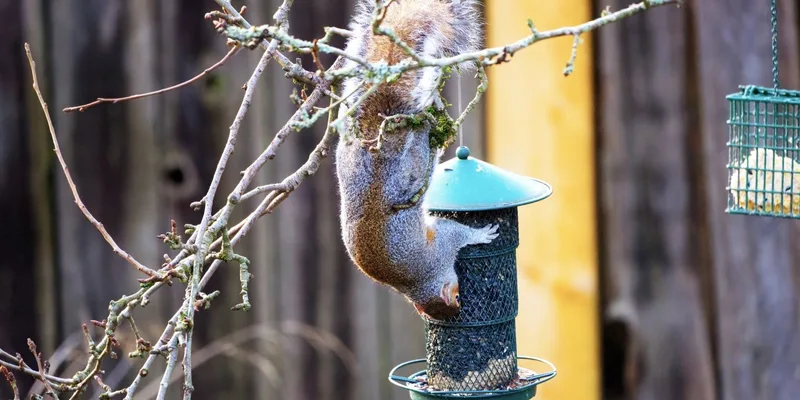
You buy the feeder, you fill it, and within three days a gray squirrel has worked out a route you did not know existed. Off the fence, along the top rail, up onto the shepherd hook, then hanging upside down with its back feet hooked over the roof. By the weekend the seed is gone and the chickadees have stopped bothering.
Plenty of feeders sold as squirrel resistant do work, but only when they hang somewhere a squirrel cannot reach around the mechanism. This guide separates the three things that keep squirrels out, and is honest about the fact that no feeder is squirrel proof in every setup.
This article contains affiliate links. If you buy through them, we may earn a commission at no extra cost to you. Learn more.
Quick Answer
What actually defeats squirrels at a bird feeder?
- A weight activated feeder, where a metal shroud drops over the ports when something heavier than a bird lands on it.
- A caged feeder, where an outer grid lets small birds through and keeps everything larger on the outside.
- A baffle on a smooth pole, set well away from anything a squirrel can launch from. Audubon puts that distance at eight to ten feet.
- All three depend on placement. A brilliant mechanism hung under an overhanging branch is still going to lose.
Bottom line: pick the mechanism that matches your yard, then measure before you hang anything. The tape measure does more work than the feeder does.
Why Squirrel Resistant Is the Honest Word
No feeder stops every squirrel in every setup. The listings say squirrel proof because that is what people search for, but the accurate word is squirrel resistant. A mechanism raises the difficulty enough that most squirrels give up and go back to the acorns, and that is a genuine win, not a marketing failure.
What decides the outcome is mechanism plus position. Cornell Lab of Ornithology notes that squirrels can jump to feeders placed less than ten feet from a tree or a building, so the same feeder can be untouchable in one spot and stripped twelve feet away.
The Three Mechanisms That Actually Work
Everything on the market is a version of one of three ideas: close the ports when weight lands, put a grid in the way, or block the approach route. Each one solves a different half of the problem, and the reason people end up buying twice is that they picked the mechanism that did not match how the squirrels get in.
Weight Activated Closure
A spring loaded shroud sits over the seed tube. Bird weight does nothing; squirrel weight pulls the shroud down and covers the ports. Audubon points out the catch: hang the feeder far enough from the pole or trunk that a squirrel cannot pull it in and feed from the side.
Cages and Grids
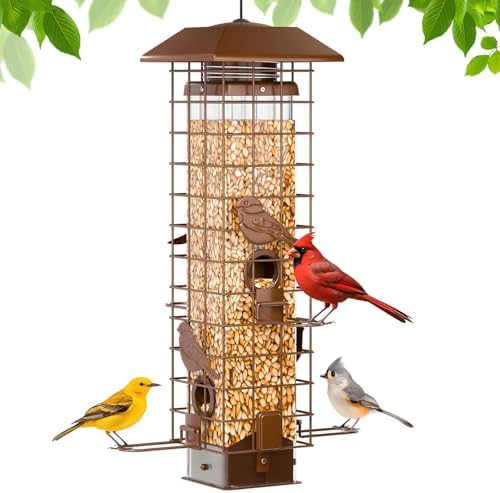
An outer cage with an opening small enough for a chickadee and too small for a squirrel. It is the most reliable mechanism because there are no moving parts to jam or freeze. The trade is that Audubon notes caged feeders also exclude larger birds, so cardinals, jays and most woodpeckers stay outside as well.
Baffles and Distance
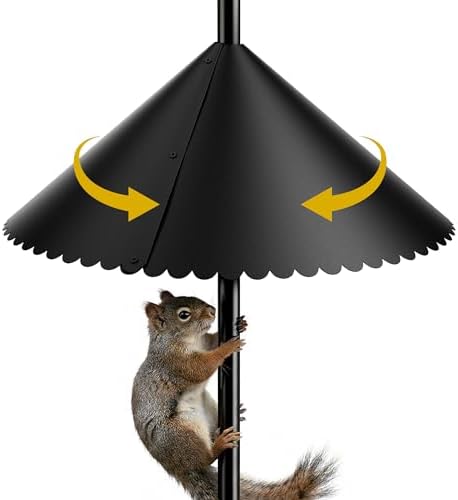
Not a feeder feature at all, but the one that changes the most. A smooth pole with a baffle below the feeder stops the climb, and clearance from fences, branches and roof edges stops the jump. Our baffle guide covers where each shape belongs.
Squirrel Resistant Feeders by Situation
Best All Around Pick for a Pole in the Open
If you have a spot at least eight to ten feet clear of a launch point, a weight activated seed tube on a baffled pole is the setup that solves the problem outright. Squirrels get one honest attempt, the shroud closes, and after a week most of them stop trying. Look for a metal shroud and metal port rims rather than plastic ones that get chewed.
When the Feeder Has to Hang From a Branch
A hanging spot under a tree gives a squirrel every advantage, so the answer here is a cage rather than a mechanism. The grid does not care whether the animal came from above or below, and there is nothing to defeat by hanging upside down. You give up the bigger birds, which is a real cost worth weighing.

If Cardinals and Jays Matter More Than Squirrels
A caged feeder shuts out the birds many people put the feeder up for in the first place. A weight activated hopper with a long perch bar is the compromise: cardinals get a place to stand and face the seed, and the bar tips under anything squirrel sized. Our guide to weight activated feeders goes into how the spring adjustment behaves.
Defending a Suet Cage
Suet is the hardest thing in the yard to protect, because it is calorie dense and squirrels will work at it for an hour. A cage around the suet basket, ideally one with a tail prop so woodpeckers can still brace, is the standard answer. There is more on the shapes in our squirrel resistant suet feeder guide.

Fixing the Pole You Already Own
If the feeder is fine and the squirrels are climbing, the cheapest fix is not a new feeder. A stovepipe or wrap around baffle on the existing pole, set at the height Audubon describes, converts a losing setup into a working one.
Comparing the Main Types
The choice is really about what you are willing to give up. Cages cost you the big birds, weight mechanisms cost you a moving part that needs cleaning, and baffles cost you the freedom to hang the feeder wherever you like.
| Type | How it stops a squirrel | What you give up | Best suited to |
|---|---|---|---|
| Weight activated tube | Shroud drops over the ports under weight | A spring and shroud to keep clean | A pole in an open spot, mixed small birds |
| Caged tube or hopper | Grid the squirrel cannot fit through | Cardinals, jays and larger woodpeckers | Hanging spots, heavy squirrel pressure |
| Weight activated hopper | Perch bar tips and closes the tray | Some capacity, and adjustment fiddling | Yards where cardinals are the point |
| Plain feeder plus baffle | Blocks the climb, distance blocks the jump | Placement freedom, needs a real pole | Keeping a feeder you already like |
Placement Does Half the Job
Two numbers do most of the work. Audubon recommends siting the feeder at least eight to ten feet from trees, buildings, fences or anything else a squirrel can launch from, and setting the baffle around four to five feet off the ground so the animal cannot jump over it from below.
Cornell Lab makes the same point from the other direction: squirrels reach feeders that sit closer than ten feet to a tree or a building. If your only spot is under a branch, buy a cage and accept it, because no spring mechanism survives an animal dropping onto the roof from above.
The Route You Have Not Noticed
Walk the yard and look at it the way the squirrel does. Fence rails, a wood pile, a garden arch, the edge of a shed roof and a low limb are all launch pads, and so is a second feeder hanging nearby. The step by step deterrent guide works through the survey in order.
Seed Choice as a Quiet Assist
Cornell Lab notes that House Sparrows, European Starlings and squirrels tend to leave safflower alone, while cardinals and other heavy billed birds take it readily, though Cornell also says squirrels in some areas have developed a taste for it.
Treat that as a helper rather than a solution. Safflower in an unprotected tray under an oak tree still empties. More on the seed side in our safflower guide.
What Not to Buy or Try
Some of the most recommended tricks online are things we will not put in a guide. Grease or petroleum jelly on a pole or a hanging wire gets onto feathers and ruins the waterproofing a bird depends on in cold rain. Spinning mechanisms that fling an animal off a perch are a broken leg waiting to happen.
Hot pepper seed sits in the same box for a different reason. Cornell Lab says squirrels may be deterred by birdseed treated with capsaicin, but also says it is unaware of research examining the effect of high doses of capsaicin on birds. That is not a green light, so we leave it alone. Poisons, traps and adhesives are out entirely; if an animal problem has gone beyond feeder management, the call is to your state wildlife agency.
Frequently Asked Questions
Is any bird feeder truly squirrel proof? No. Squirrel resistant is the honest term. A good mechanism on a baffled pole with real clearance defeats almost all of them, but a determined animal with a launch point will eventually find a way in. Placement is what turns a good feeder into an effective one.
Do weight activated feeders keep out big birds too? Usually yes, if the spring is adjustable. Tightening it enough to close under a grackle or a dove also closes it under a cardinal, so most people set it to shut out squirrels and accept that the larger birds still feed.
Will a caged feeder stop cardinals from coming? Mostly. Audubon notes caged feeders exclude larger birds along with squirrels. If cardinals are the reason you feed, use a weight activated hopper with a perch bar, or run a separate open tray away from the protected feeder.
How far from a tree should a squirrel resistant feeder go? Audubon suggests at least eight to ten feet from trees, buildings and fences, and Cornell Lab notes squirrels reach feeders sited closer than ten feet to a tree or a building. Measure it rather than guessing from the kitchen window.
Can I just use hot pepper seed instead? We do not recommend it. Cornell Lab says squirrels may avoid capsaicin treated seed but that it is unaware of research on the effect of high doses on birds.
The Bottom Line
Buy the mechanism that fits your yard rather than the one with the strongest claim on the box. Open spot with a pole, buy weight activated and baffle the pole. Hanging spot under a tree, buy a cage and accept that the jays stay out. Then measure the clearance before you hang it, because the placement decides whether the mechanism ever gets a chance to work. Read next: our baffle shapes guide and the feeder pole guide for the diameter that baffles actually fit.