Last updated: August 21, 2026
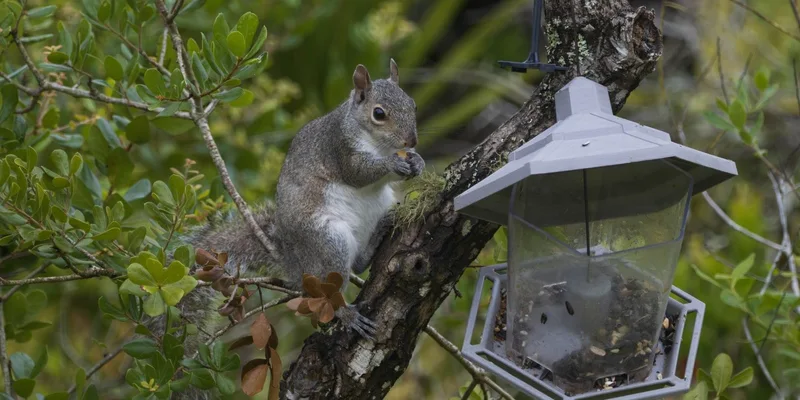
Most advice about squirrels at feeders is a list of tricks, and most of the tricks do not survive a second week. The animal is a good climber, a better jumper and extremely persistent, and it has all day. What works is not cleverness, it is geometry: put the feeder somewhere the squirrel cannot reach, and block the one route that is left.
This is the order to work through, from the free step that fixes the most yards to the hardware that finishes the job. It also covers the popular methods we will not recommend, and why, because a few of them hurt animals rather than just moving them along.
This article contains affiliate links. If you buy through them, we may earn a commission at no extra cost to you. Learn more.
Quick Answer
How do you keep squirrels out of bird feeders?
- Move the feeder first. Audubon suggests at least eight to ten feet from trees, fences, roofs and anything else a squirrel can launch from.
- Put it on a smooth pole with a baffle set roughly four to five feet off the ground.
- Add a mechanism only if the geometry cannot be fixed: a cage, or a weight activated feeder.
- Switch seed as a helper. Cornell Lab notes squirrels tend to leave safflower alone, though some have developed a taste for it.
Bottom line: the tape measure comes before the shopping. Placement fixes more yards than any product does.
Step One: Survey the Launch Points
Before buying anything, walk out and look at the feeder from a squirrel’s point of view. Cornell Lab of Ornithology notes that squirrels can jump to feeders placed less than ten feet from a tree or a building, so the job is to find every surface within that distance and either move the feeder or accept it will lose.
Count everything: fence rails, the shed roof, the deck edge, a low branch, a garden arch, a wood pile, a patio chair left out. Audubon’s version of the rule is eight to ten feet of clearance from trees, buildings and fences, and its practical summary is that the best weapon against a squirrel is a tape measure.
Step Two: Get It Onto a Pole
A feeder hanging from a branch has an approach route from above that nothing on the pole side can stop. Moving it to a freestanding pole in an open spot reduces the problem to a single vertical climb, which is a problem with a solution.
Smooth matters here. A plain steel shaft with no couplers, arms or brackets low down leaves nothing to brace against, while twisted, scrolled or sectional poles give a climbing animal footholds. Our feeder pole guide covers diameter, height and ground anchoring in detail.
If It Has to Hang
Sometimes a branch is the only option. In that case the answer is a wide dome above the feeder rather than anything below it. Cornell Lab suggests a tilting baffle at least eighteen inches in diameter for squirrels coming from overhead.
Step Three: Add the Baffle
A baffle is the highest value item in this whole exercise. It is a smooth barrier on the pole that a squirrel cannot climb over, and Audubon’s guidance is to set it around four to five feet off the ground so the animal cannot simply leap past it from the grass.
Shape follows the approach. A stovepipe or torpedo goes under a pole mounted feeder, a dome goes above a hanging one, and a wrap around clamps onto a pole already in the ground. Our baffle guide covers which one belongs where and the diameters that fit.
Step Four: Change the Feeder if You Still Need To
If the geometry genuinely cannot be fixed, because the only spot is under a tree or on a small deck, then the mechanism has to do the work. Two designs are reliable, and they cost you different things.
A caged feeder puts a grid between the animal and the seed and has nothing to jam or freeze, but Audubon notes it excludes larger birds along with squirrels, so cardinals and jays stay outside. A weight activated feeder drops a shroud over the ports under squirrel weight and keeps the big birds, but needs to hang far enough from the pole that the animal cannot pull it in. Both are covered in our squirrel resistant feeder guide and, for the mechanism itself, our weight activated feeder guide.
Step Five: Change What Is in It
Seed choice will not fix a badly placed feeder, but it shifts the odds on a well placed one. Cornell Lab notes that House Sparrows, European Starlings and squirrels tend to leave safflower alone, while cardinals and other heavy billed birds take it readily, and it adds that squirrels in some areas seem to have developed a taste for it.
The other half is what falls to the ground. Hulled or no mess mixes leave far less underneath, which removes the reason squirrels patrol the area in the first place. More on that in our safflower guide and the no mess seed guide.
What Works and What Does Not
Every method people try falls into one of three groups: it changes the geometry, it changes the feeder, or it is a story someone told on the internet.
| Method | Does it work | Effort | Notes |
|---|---|---|---|
| Moving the feeder into the open | Yes, most of the time | Free, one afternoon | Eight to ten feet of clearance |
| Baffle on a smooth pole | Yes, with correct height | Low | Around four to five feet up |
| Caged feeder | Yes, reliably | Low | Keeps larger birds out too |
| Weight activated feeder | Yes, if hung clear of the pole | Low, needs cleaning | Adjustable spring on better models |
| Safflower seed | Sometimes, as a helper | Low | Some squirrels take to it |
| Slinky, string runs, spinning hooks | Unreliable, and some are unsafe | Varies | Nothing that flings an animal |
What We Will Not Recommend
Grease, cooking oil and petroleum jelly on a pole or a hanging wire are all over the internet and they are genuinely harmful. Any bird that brushes the coated surface gets it on its feathers, and greased feathers do not shed water or hold warmth. This is the one piece of common advice worth actively arguing against.
Hot pepper and capsaicin treated seed is a separate case. Cornell Lab says squirrels may be deterred by seed treated with capsaicin, but also says it is unaware of research examining the effect of high doses of capsaicin on birds, which is not the same as saying it is fine. Traps, poisons, adhesives, electric deterrents and spinning mechanisms that throw an animal off are all out. If the situation has gone past feeder management, the contact is your state wildlife agency, not a hardware fix.
Frequently Asked Questions
What is the single most effective thing I can do? Move the feeder. Audubon suggests at least eight to ten feet from any launch point, and Cornell Lab notes squirrels reach feeders closer than ten feet to a tree or a building. It costs nothing and it fixes more yards than any product.
Do squirrel deterrent sprays work? We do not recommend them. The evidence is thin, they wash off, and anything applied to seed or to a feeder ends up in contact with birds. Geometry and a baffle achieve the result without the open questions.
Should I feed the squirrels separately to distract them? Some people do, and it can reduce pressure on the feeder, but it also raises the number of squirrels the yard supports. If you try it, put the corn or peanut feeder well away from the bird feeders rather than next to them.
Will a slinky on the pole stop them? Sometimes, and it is harmless, but it is unreliable and it looks like what it is. A proper baffle at the right height does the same job every day of the year.
Why do squirrels still get in with a baffle fitted? Nearly always height or clearance. The baffle is too low to stop a jump from the ground, or the feeder is within jumping range of a fence or a branch, so the pole never enters into it.
Is there a feeder that stops squirrels completely? No feeder is squirrel proof in every setup, which is why squirrel resistant is the honest term. A cage or a weight activated mechanism on a baffled pole with real clearance stops almost all of them.
The Bottom Line
Work in order: measure the clearance, move the feeder onto a smooth pole, add a baffle at the right height, and only then change the feeder itself. Seed choice helps at the margins. Skip anything that greases, poisons, traps or flings, and call your state wildlife agency if the problem has grown past feeders. Read next: our squirrel resistant feeder guide and the baffle shapes guide.