Last updated: August 21, 2026
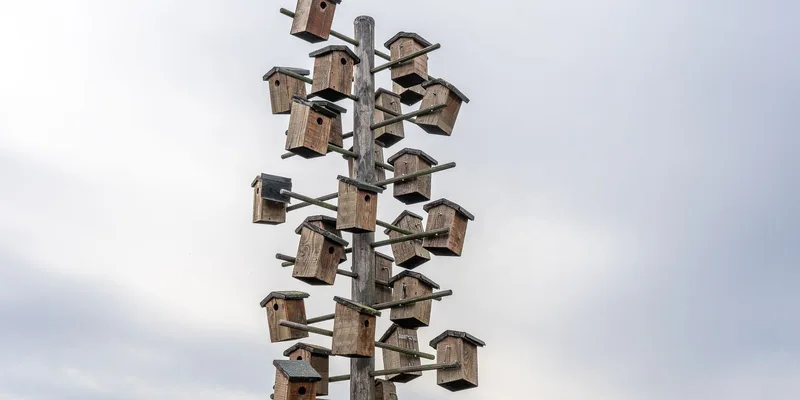
Every other nest box in this niche is a thing you screw to a post and check twice a summer. A purple martin house is not that. It is a multi compartment apartment block on a tall pole in the middle of an open space, it needs a clear circle around it that most suburban lots simply do not have, and the people who run them successfully talk about being landlords rather than about owning a birdhouse. Going in knowing that saves a lot of disappointment.
It is also the single most consequential box you can put up. The Cornell Lab of Ornithology describes eastern Purple Martins as now nesting almost exclusively in birdhouses, while in the West they still mostly use woodpecker holes. In the eastern half of the continent the species depends on people putting housing out, which is a good reason to get the setup right rather than half right.
This article contains affiliate links. If you buy through them, we may earn a commission at no extra cost to you. Learn more.
Quick Answer
What do you need before buying a purple martin house?
- Open space. NestWatch says there should be no trees or buildings within sixty feet of the martin pole in any direction.
- Height. NestWatch puts the housing at ten to fifteen feet from the ground, on a pole.
- A pole you can lower. NestWatch recommends a system that lowers for cleaning, which is how the colony gets managed at all.
- Patience with competitors. NestWatch advises keeping compartments closed until martins return and using starling resistant entrance holes.
Bottom line: measure the open space first. If you do not have the clearance, no amount of housing quality will fix it.
The Clearance Rule Comes First
Purple martins want open air around the nest, and NestWatch is unusually specific: there should be no trees or buildings within sixty feet of the martin pole in any direction, and the area beneath the housing should be kept free of brush and shrubs. That is a circle of open ground, not a gap between two hedges.
This is the single reason most purple martin houses stay empty. A pole squeezed into the back corner of a fenced lot, with a mature maple on one side and a garage roof on the other, does not meet the condition, and martins will pass over it year after year. Measure before you buy, not after.
What Counts as Good Habitat
NestWatch describes purple martins nesting in deserts, lakeside areas and towns, so this is not a wilderness bird. It is an open country bird, and open lawns, playing fields, farm yards and waterfronts are the settings where colonies establish. Water nearby is a genuine advantage, and NestWatch notes that mounting over water reduces problems with starlings, sparrows and predators.
Height, Orientation and the Pole
NestWatch gives ten to fifteen feet from the ground for purple martin housing, mounted on a pole, with entrance holes facing south or west, and separate houses spaced about ten feet apart. That is considerably higher than a bluebird box, and it is the reason the pole is the expensive and important half of the purchase.
The pole also has to come down. NestWatch recommends a pole system that can be lowered for cleaning, and in practice that is what makes a colony manageable: checking compartments, clearing old nests, adding pine wood chips in spring, which NestWatch also suggests, and dealing with competitors all require getting to the housing.
Telescoping, Winch or Fixed
Fixed poles exist and should be avoided for this species, because a house you cannot reach is a house you cannot run. Telescoping poles slide down by hand and suit smaller houses; winch systems crank a heavy multi compartment block or a gourd rack down smoothly and are worth it once the housing gets big. Either way, check the maximum load the pole is rated for in the listing against the housing you are pairing it with.
Purple Martin Housing by Situation
Best All Around Choice in the East
A multi compartment house on a telescoping or winch pole is the eastern standard, and it matches how the birds behave: these are social, colonial nesters that readily accept multi compartment housing. NestWatch also suggests painting houses white. Buy the house and the pole as a matched system if you can.

Gourds, Especially in the West
NestWatch notes that western populations take to clustered gourds, and gourd racks are popular in the east as well. Gourds are light, easy to lower and inspect one at a time, and simple to add to as a colony grows. A rack of gourds on a winch pole is the setup a lot of long running colonies end up with.

The Pole on Its Own
If you already have housing, or you are buying a house and a pole separately, this is the part not to economize on. A pole that lowers smoothly under load gets used; one that binds or needs two people gets left up, and an unmanaged colony house fills with starlings and sparrows within a season.

Competition, and How the Sources Say to Handle It
European Starlings and House Sparrows will take purple martin compartments given the chance, and both are more likely to be in residence early because martins arrive later. NestWatch’s approach is timing and design: keeping compartments closed until purple martins return to their breeding habitat reduces the competition, and starling resistant entrance holes limit starling access.
That is the whole toolkit available to a backyard landlord, and it is exclusion rather than removal. What is and is not permitted with nesting birds is set in law and varies by state, so anything beyond keeping compartments shut and choosing the right entrance shape is a question for your state wildlife agency.
The NestWatch Setup at a Glance
These figures come from the NestWatch page for the Purple Martin. Entrance hole dimensions vary between plans and between starling resistant designs, so take those from the housing manufacturer or the NestWatch construction plan rather than from a general guide.
| Setup point | NestWatch guidance | Why it matters | Common mistake |
|---|---|---|---|
| Clearance | No trees or buildings within sixty feet | Martins need open flight lines | A pole in a corner of a fenced yard |
| Height | Ten to fifteen feet, on a pole | How the birds approach the housing | Mounting at bluebird box height |
| Orientation and spacing | Holes face south or west, houses about ten feet apart | Sun, weather and colony layout | Two houses crowded together |
| Access | A pole that lowers for cleaning | Monitoring, cleaning and competitors | A fixed pole you cannot reach |
Running a Colony Through the Year
The season starts before the birds do. Compartments stay closed over winter and through early spring, and NestWatch’s advice is to open them once purple martins return to your area, which keeps starlings and sparrows from settling in first. Adding pine wood chips to compartments in spring is also on the NestWatch list.
After the season the housing comes down, gets cleaned out, and goes back up closed. That annual rhythm is the difference between a colony that grows and a house that hosts martins once and starlings thereafter. It is also why the lowering system matters more than any feature of the house itself.
Frequently Asked Questions
How high should a purple martin house be? NestWatch puts purple martin housing at ten to fifteen feet from the ground, mounted on a pole, with entrance holes facing south or west and separate houses spaced about ten feet apart.
How much open space does a purple martin house need? NestWatch says there should be no trees or buildings within sixty feet of the martin pole in any direction, and that the area beneath the housing should be kept free of brush and shrubs. This is the requirement most yards fail.
Houses or gourds, which is better? Both work. NestWatch notes eastern populations readily accept multi compartment houses while western populations take to clustered gourds. Gourds are lighter and easier to inspect individually, which is why many established colonies use racks of them.
Why is my purple martin house empty? Most often clearance or height. After that, competition: starlings and sparrows moving in before martins arrive. NestWatch advises keeping compartments closed until purple martins return and using starling resistant entrance holes.
Do purple martin houses need to be white? NestWatch suggests painting houses white for better attraction. It is one of the small things worth following, along with the pine wood chips it recommends adding to compartments in spring.
Do purple martins really control mosquitoes? That claim gets attached to martin housing a lot and it is not why the birds are worth hosting. Put housing up because eastern martins depend on it, as the Cornell Lab describes, rather than as pest control. For mosquito issues at water, see our guide on mosquitoes in a bird bath.
The Bottom Line
Check the sixty foot clearance before you look at a single product photo, because that is the condition that decides everything else. Then buy the pole and the housing together, choose a system you can lower single handed, and plan on opening compartments only when the martins arrive. It is a bigger commitment than a nest box and a more meaningful one. Read next: our bluebird house guide if the clearance is not there, where to hang a birdhouse, and the birdhouse hole size table.