Last updated: August 21, 2026
Most unused birdhouses are not badly built. They are badly placed. A box nailed to a tree trunk at head height in a shady corner is doing everything wrong at once, and the birds that walk past it every day are not being fussy, they are avoiding a cavity that a raccoon could empty in ten seconds.
Placement is also the part of nest box keeping where good published guidance exists. NestWatch, the Cornell Lab of Ornithology’s nest monitoring project, publishes placement advice per species and general guidance on mounting and predator guards. This article works through that, and through the practical business of getting a pole into the ground straight.
This article contains affiliate links. If you buy through them, we may earn a commission at no extra cost to you. Learn more.
Quick Answer
Where should you hang a birdhouse?
- On a free standing metal or PVC pole, not on a tree. NestWatch calls poles the best way to install small nest boxes because predators find them hard to climb.
- With a baffle underneath. NestWatch advises fitting the box about six inches above the top of a stovepipe baffle.
- Entrance facing away from prevailing winds, and for bluebirds facing toward a tree or shrub the young can fly to.
- Away from overhanging branches, which give snakes and squirrels a route in from above.
Bottom line: a smooth pole, a baffle below the box, clear air above it, and the hole turned away from the weather.
Pole First, Tree Last
NestWatch is explicit that the best way to install small nest boxes is on free standing metal poles or PVC pipe. The reasons they give are that a pole lets you mount the box higher than a fence post, that many predators find a smooth pole difficult to climb, and that a pole can easily be fitted with a predator guard.
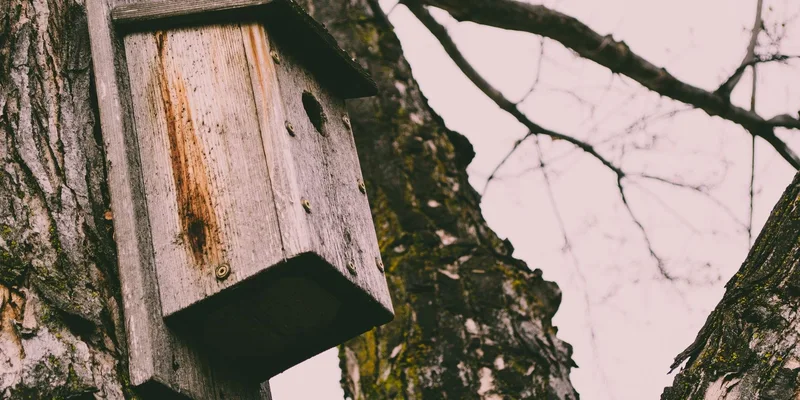
Galvanized pipe and PVC are both slick enough that most climbing predators struggle. A wooden post is not, and a tree trunk least of all, because a tree gives a raccoon, a squirrel and a rat snake a textured surface and a route from the canopy. A box on a tree is a box you are choosing not to protect.
If a Tree Is Your Only Option
Some species do best on trees and some yards have nowhere else. In that case use a proper tree mount that does not damage the trunk, keep the box clear of branches a predator can drop from, and understand that a tree mounted box carries more risk. NestWatch has published specifically on protecting tree mounted boxes from snakes, and that is the place to read up before you commit.
Height, and Why the Answer Is Per Species
There is no single correct height, only a published figure per bird. For Eastern Bluebirds the guidance is to mount the box so the entrance hole sits about five feet above the ground. House Wren boxes are commonly placed at a similar height with the entrance facing east, away from afternoon sun and north winds.
Do not translate those figures onto other species. Tree Swallows, chickadees, titmice and woodpeckers each have their own published range on the NestWatch species pages, and the difference between them is not arbitrary. Look up the bird you are targeting, which you should already have done to get the entrance hole size right.
What the Box Should Face
Two rules, and they usually agree. Position the entrance facing away from prevailing winds so gusts and driven rain do not blow into the cavity. Then, if you can, aim it at something useful: bluebird guidance is to face the box toward a tree or shrub within about a hundred feet, which gives fledglings a target on their first flight.
In practice that often means facing east or southeast in much of North America, which also keeps the entrance out of the hottest afternoon sun. If the two rules conflict in your yard, wind protection wins, because a soaked nest is a failed nest.
Sun and Shade
A dark box in full sun gets genuinely hot inside, and boxes in open country are more exposed than boxes at a woodland edge. Partial afternoon shade is helpful in hot regions, provided it does not come from branches directly over the box. Light colored boxes and adequate ventilation holes help for the same reason.
Predator Guards Are Part of Placement
A box on a pole without a baffle is only half installed. NestWatch describes cone and stovepipe baffles fitted below the box to stop climbing predators including snakes, raccoons, chipmunks and mice, and gives a specific fitting detail: when installing a stovepipe baffle, the nest box should sit about six inches above the top of the baffle.
The other half is what is above the box. NestWatch advises keeping pole mounted boxes away from trees so snakes cannot reach them from overhead branches. A baffle stops something climbing the pole; nothing stops something that drops onto the roof.
| Mounting | Climbing predator risk | Guard options | Best suited to |
|---|---|---|---|
| Metal or PVC pole | Lowest, smooth surface | Stovepipe or cone baffle below | Bluebirds, swallows, most small boxes |
| Wooden fence post | High, easy to climb | Limited, baffles fit poorly | Last resort only |
| Tree trunk | Highest, plus canopy access | Trunk wraps, with mixed results | Woodland species where no pole is possible |
| Hanging from a branch | High, swings and reachable | Very few | Decorative boxes, rarely occupied |
Spacing and Neighbors
Territorial birds do not want a second box in sight. For Eastern Bluebirds the published spacing guidance is roughly a hundred yards between boxes, which in most backyards means one box, not four. Cramming boxes into a small yard produces fights, not more nests.
Habitat also decides who you get. Open lawn with scattered perches suits bluebirds and swallows; a yard with shrubs and a tangle of cover suits wrens and chickadees. A box in the wrong habitat stays empty regardless of how well it is mounted, which is why our wren house guide and the bluebird house guide both start with what the yard looks like.
Getting the Pole In Straight
Drive the pole deep enough that it does not lean when you lean on it, and check it with a level in two directions before the box goes on. A box that tips forward sheds rain off the roof and away from the hole, which is fine; a box that tips backward funnels water in.
Mount the box so you can open it. Nest boxes need to be checked and cleaned out, and a box at the top of a pole you cannot reach is a box you will stop maintaining after one season. If it is high, plan for how you will get to it before you set the pole.
Frequently Asked Questions
How high should a birdhouse be? It depends on the species. For Eastern Bluebirds the published guidance is an entrance hole about five feet above the ground, and House Wren boxes are commonly set at a similar height. Check the NestWatch page for the bird you are targeting rather than using one number everywhere.
Which direction should the entrance face? Away from prevailing winds. For bluebirds, guidance is also to face the box toward a tree or shrub within about a hundred feet so fledglings have somewhere to aim for. East or southeast satisfies both in much of the country.
Can I put a birdhouse on a tree? You can, but NestWatch recommends free standing poles because predators find them harder to climb and because a pole takes a baffle. A tree mounted box needs extra thought about snakes and about branches above it.
Do I really need a baffle? If the box is on a pole, yes. NestWatch describes cone and stovepipe baffles as one of the most effective protections against climbing predators, fitted below the box with the box roughly six inches above the top of the baffle.
How many boxes can I put in a small yard? Usually one for a territorial species. Bluebird guidance puts boxes about a hundred yards apart, so a typical suburban lot supports a single bluebird box, though a wren box in a different habitat corner can coexist.
When should the box go up? Before the nesting season starts locally, which for most of the country means late winter into early spring. A box that is already weathered and in place when birds start prospecting does better than one hung the week they arrive.
The Bottom Line
Put the box on a smooth free standing pole, fit a baffle underneath it, keep branches from overhanging it, face the entrance away from the wind, and use the height NestWatch publishes for the species you are aiming at. Placement decides occupancy more than the box does. If you have not chosen a species yet, start with the hole size table, then the bluebird house or wren house guide depending on what your yard looks like.