Last updated: August 21, 2026
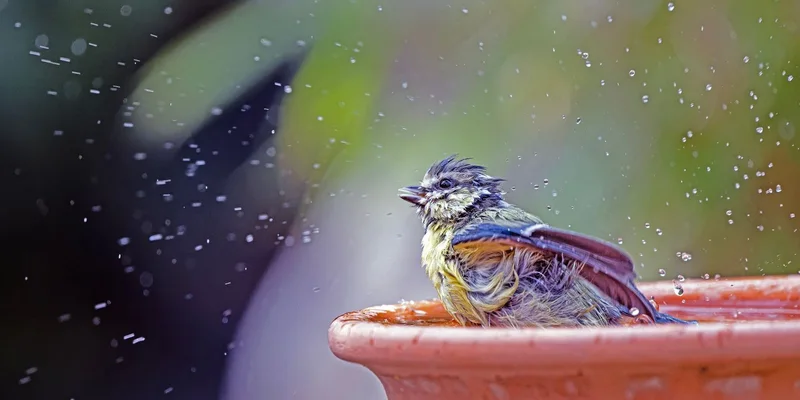
Watch a chickadee approach a deep bird bath and you can see the calculation happen. It lands on the rim, leans over, dips a bill, and leaves. It never steps in, because it cannot tell where the bottom is and it is not going to find out the hard way with a hawk somewhere in the neighborhood. Depth is not a detail on a bird bath. It is the specification the whole thing lives or dies on.
The number that keeps coming back from the people who study this is small. The National Audubon Society recommends a maximum of about two inches at the deepest point, with the basin sloping in gradually from the rim, and Audubon’s own build guide describes water roughly an inch to an inch and a half deep. Almost every bath sold as a garden ornament is deeper than that.
This article contains affiliate links. If you buy through them, we may earn a commission at no extra cost to you. Learn more.
Quick Answer
How shallow does a bird bath need to be?
- About two inches at the deepest point, which is the maximum the National Audubon Society recommends.
- Sloping, not flat. A gradual slope from the rim gives small and large birds their own depth in one bowl.
- Textured. A shallow bath with a glazed floor still fails, because wet feet find nothing to grip.
- Fixable. If the bath you own is too deep, Audubon suggests adding a few large pebbles or a flat stone.
Bottom line: buy the shallow sloped bowl, and if you already own a deep one, stone it rather than replace it.
Why Two Inches Is the Number
A songbird bathes by standing in water and flicking it through its feathers, which means it has to be able to stand. Water deeper than about the height of its legs stops being a bath and starts being a hazard, and a bird that cannot see the bottom will not commit. That is the reason the National Audubon Society sets the maximum at about two inches at the deepest point.
Wet feathers are the other half of it. A soaked bird flies poorly for a minute or two, and every bathing bird knows it. Shallow water means it can leave in one movement rather than hauling itself out of a bowl, and that difference is why a shallow bath fills up while a deep one next to it stays empty.
Slope Does More Than Depth Alone
A flat floored bowl gives every bird the same depth. A sloped basin gives a warbler an inch at the edge and a jay two inches in the center at the same time, in the same bath. That is why Audubon’s phrasing is about the basin sloping gradually inward from the rim rather than a single number, and why a sloped bowl serves a much wider range of species.
Texture: The Other Half of the Problem
A shallow bath with a slick floor is still a bath birds avoid. Wet feet need grip, and glazed ceramic, polished stone and smooth molded resin give none. Rough concrete, unglazed pottery, hammered metal and textured resin all give a bird something to hold, which is what lets it settle rather than skid.
You can test it in the store with a wet hand. If the inside of the basin feels slippery to your fingertips, it will feel considerably worse to a bird balancing its whole weight on two toes in moving water. Product photos flatter glossy finishes, so this is a detail worth checking in the listing text or in a customer photo.
Shallow Bird Baths by Situation
Best All Around Choice
A wide, shallow, gently sloping bowl with a rough interior is the pick, whether it sits on a pedestal, a stump or a low wall. Width matters more than depth here, because a wide bowl gives several birds room at once and gives each of them a choice of depth along the slope.

For Ground Feeding Species
Doves, towhees, thrushes and sparrows take water at ground level far more readily than on a pedestal. A shallow saucer set into a border, with a shrub a hop away, brings in birds a raised bath never will. Keep it out of dense low cover at the very edge so a cat has no hiding place.

For a Deck, a Balcony or a Window
Where there is no ground and no pedestal, a shallow dish that hangs from a hook or clamps to a rail gets water to the birds. Small dishes go warm and low fast in sun, so plan on a daily top up, and hang it from something rigid, because birds dislike a bath that swings.

If You Already Own a Deep Pedestal
You do not have to replace the base. A shallow replacement basin sized to your pedestal turns a deep ornamental bath into a usable one, and it is often the cheaper half of the original purchase. Measure the top of the pedestal before ordering, since bowls and bases are not standardized across makers.

Depth by Bird, in One Table
These are the working depths a sloped basin provides at different points, not rules to measure with a ruler. The point of a sloping bowl is that all of them exist at once, which is what a flat floored bath cannot offer.
| Zone of the bowl | Typical users | What they do there | Design point |
|---|---|---|---|
| Rim and dry edge | Hummingbirds, warblers, kinglets | Drink, then bathe in spray or wet leaves | A wide flat rim to perch on |
| Shallow slope | Chickadees, finches, titmice, wrens | Stand and flick water through feathers | Gradual slope, rough surface |
| Deepest point | Cardinals, jays, robins, grackles | Wade in and bathe properly | About two inches, per Audubon |
| Ground level version | Doves, towhees, thrushes, quail | Drink and bathe without climbing | Saucer set low, cover a hop away |
Making a Deep Bath Shallow
If you already own a bath that is too deep, the fix costs nothing. Audubon’s own suggestion for a basin deeper than ideal is to add a few large pebbles or a flat stone, which lets birds judge the depth and gives them something to stand on above the floor. It is the single most effective change you can make to an existing bath.
Choose the stones with cleaning in mind. A handful of large flat pieces lifts out in seconds; a layer of small gravel traps droppings and seed hulls and turns every clean into an archaeological dig. Our guide to stones in a bird bath covers how to do it without creating that problem.
Keeping a Shallow Bath Full and Clean
A shallow bath loses water faster, which is the honest trade for a bath birds use. In summer sun a two inch basin drops noticeably in a day, so it wants topping up rather than refilling from empty. Audubon recommends freshening the water every other day, which handles both the level and the hygiene at once.
For the scrub, Audubon gives one part vinegar to nine parts water and advises against synthetic soaps and cleansers because they can strip the essential oils off bird feathers. It also links dirty birdbaths to the spread of house finch eye disease, salmonellosis and avian pox, so the routine matters more than the bowl you bought.
Frequently Asked Questions
How deep should a bird bath be? The National Audubon Society recommends a maximum of about two inches at the deepest point, with the basin sloping gradually inward from the rim. Audubon’s own birdbath build describes water roughly an inch to an inch and a half deep.
My bath is too deep. Do I have to replace it? No. Audubon suggests adding a few large pebbles or a flat stone so birds can judge the depth and stand above the floor. Use a few big pieces rather than gravel, so the bath still cleans out easily.
Is a shallow bird bath safe for small birds? That is exactly why it is recommended. Shallow water lets a small bird stand and leave in one movement, which matters because wet feathers make flight harder for a minute or two after a bath.
Does the material matter as much as the depth? Almost. A shallow bath with a glazed or polished floor still gets refused, because wet feet need grip. Rough concrete, unglazed pottery, textured resin and hammered metal all work.
How often does a shallow bath need topping up? Most days in summer, since there is not much water in it to begin with. Audubon recommends freshening the water every other day in any case, which covers both the level and keeping it clean.
Will a shallow bath freeze faster in winter? Yes, there is less water to hold heat. That is a reason for a heated bath in cold regions rather than a reason to buy a deeper bowl, because depth is what stops birds using it.
The Bottom Line
Two inches at the deepest point, a gradual slope from the rim and a rough surface underfoot is the entire specification for a bath birds will stand in. Everything else, pedestal or ground, stone or resin, fountain or still, is preference. If your bath is already too deep, a handful of flat stones fixes it this afternoon. Read next: our full bird bath buying guide and stones in a bird bath for the cheap fix, plus how to clean a bird bath.