Last updated: August 21, 2026
The sound is unmistakable and you never get used to it. A thump on the glass, and either a bird sitting stunned on the deck or a small smudge of feather dust on the pane where one hit and kept going. In most houses it is not random either: it is the same window, over and over, usually the one that reflects a tree or a stretch of open sky.
The good news is that this is a solvable problem, and it is solvable on the specific pane that keeps causing it rather than on the whole house. The bad news is that most of what people try first, a single hawk silhouette in the middle of the glass or a decal stuck on the inside, does not work, and the reasons why are well documented by the American Bird Conservancy and the Cornell Lab of Ornithology.
This article contains affiliate links. If you buy through them, we may earn a commission at no extra cost to you. Learn more.
Quick Answer
How do you stop birds hitting your windows?
- Cover the outside of the glass, not the inside. The American Bird Conservancy says the best place to apply a solution is the outside, where it is visible.
- Use a close pattern. ABC advises leaving no gaps wider than about two inches, so a bird sees no way through.
- One decal does nothing. A single silhouette leaves the rest of the pane looking flyable.
- Move the feeder. The Cornell Lab’s advice is to place feeders either within about three feet of the glass or more than about thirty feet away.
Bottom line: treat the whole outside of the problem pane with a close pattern, and reposition any feeder near it.
Why Birds Hit Glass
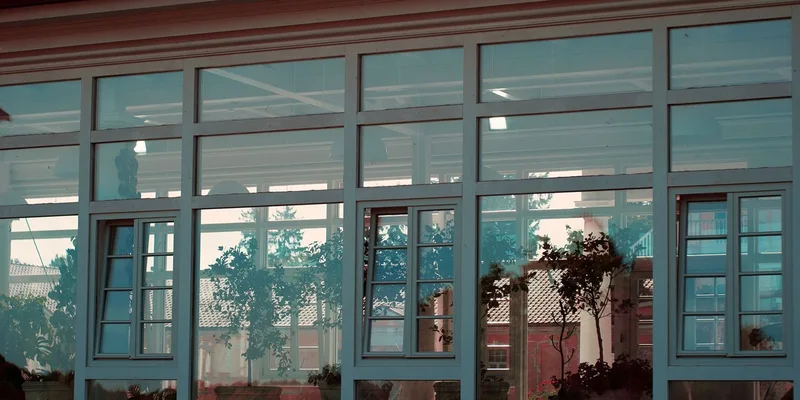
Birds do not see glass. What they see is what the glass shows them: a reflected tree, a reflected hedge, a reflection of the sky, or straight through a corner window to a bright room and out the other side. All of those read as open flight paths, and a bird moving fast has no reason to doubt them.
That explains the pattern most people notice at home. Collisions cluster on large panes, on windows that reflect vegetation, and on windows near feeders where startled birds take off in a hurry. It also explains why the fix has to be on the outside: anything behind the glass sits behind the reflection and the bird never sees it.
Two Seasons, Two Causes
Spring and fall migration bring birds through yards they do not know, and that is when most collisions happen. Spring also brings a different behavior entirely: a bird repeatedly attacking its own reflection in a window or a wing mirror, which is territorial display rather than a collision. That one stops when the reflection is broken up, which the same external treatments do.
The Spacing Rule That Actually Matters
The American Bird Conservancy’s guidance is stated in terms of gaps rather than of decals: whatever pattern you use should not leave spaces more than about two inches wide, because the aim is that a bird sees no viable route between the markers. ABC also notes that the material needs to be visible from at least ten feet away so the bird has time to change course.
That is why a lone hawk silhouette fails. It marks a few square inches of a pane and leaves the rest looking exactly as flyable as before. Cornell’s guidance runs the same direction, describing closely spaced external markers rather than a single ornament.
Which Windows to Treat
Start with the pane where strikes actually happen, and with any large window that mirrors trees or shrubs. Go outside on a bright day and look at your house from where the birds fly in from. The windows that show you a tree are the windows that need work; the ones showing you a dark room usually do not.
What Goes on the Glass
Dots, Films and Tapes
Adhesive dot patterns and translucent films applied to the outside surface are the most common home solution, and they satisfy the spacing rule by design. Look for a pattern rated for external application, since interior only products are exactly the mistake described above.

Cords, Screens and Physical Barriers
Vertical cords hung a few inches apart in front of the pane, or an insect screen fitted on the outside, break up the reflection and also cushion any bird that does reach the glass. These are the least visually intrusive option from inside the house, which matters if the window is the one you actually look out of.

Comparing the Options
Four approaches cover almost every house. They differ mostly in how long they last outdoors and how much you notice them from indoors.
| Solution | Goes on | Outdoor durability | Best suited to |
|---|---|---|---|
| Dot decals or patterned film | Outside surface | Seasons, varies by product | The single problem pane |
| Vertical cords in front of glass | Outside, above the frame | Long, few parts to fail | Large picture windows |
| Exterior insect screen | Outside frame | Long | Windows that already take screens |
| Single silhouette sticker | Usually inside | Irrelevant | Not effective, skip it |
Move the Feeder, Not Just the Glass
Feeders change the geometry of a yard. A startled bird leaving a feeder accelerates fast and has very little distance in which to notice a window. The Cornell Lab’s guidance is to place feeders either very close to the glass, within about three feet, or well away from it, more than about thirty feet.
The close option works because a bird leaving a feeder that near the pane has not built up speed. That is also why window mounted feeders are not the hazard people assume: our guides to the window bird feeder with camera and the window hummingbird feeder both cover the mounting side, and the same three foot logic applies to both.
Also Look at What Is Behind the Glass
A houseplant right behind a window reads as habitat to a bird outside, and a corner room with windows on two walls reads as a clear passage. Moving a plant back from the sill and closing a blind on the far side of a see through room both reduce the illusion at no cost.
If a Bird Hits Anyway
A stunned bird often recovers on its own after a while sitting still. Keep pets indoors and give it space rather than handling it. If the bird is clearly injured, does not recover, or is a species you are unsure about, the right contact is a licensed wildlife rehabilitator or your state wildlife agency, who can tell you what to do next.
Do not attempt treatment, food or water yourself. Handling a stunned bird more than necessary adds stress, and the people licensed to deal with wildlife casualties exist precisely so that this decision is not yours to make.
Frequently Asked Questions
Do window decals actually work? Only when they are on the outside and closely spaced. ABC’s guidance is to leave no gaps wider than about two inches and to make sure the material is visible from at least ten feet away. A sparse scattering of stickers on the inside does not change what the bird sees.
Does a hawk silhouette help? Not by itself. It covers a small part of the pane and leaves the rest looking open. The effect that matters comes from covering the whole window with a close pattern, not from the shape of any one marker.
Where should I put my bird feeder to reduce strikes? The Cornell Lab advises either within about three feet of the window or more than about thirty feet away. Close in means birds cannot build up speed; far out means they have room to see the glass.
Will ultraviolet stickers work if I cannot see them? Products marketed on ultraviolet visibility vary a lot in how they perform, and ABC’s own advice is built around patterns that are visible and closely spaced. If you want certainty, choose something you can see on the outside of the glass.
A bird keeps attacking its reflection. Is that the same thing? No, that is territorial behavior, usually in spring. Breaking up the reflection on the outside of that pane is the fix, and it typically stops once the breeding season passes.
What do I do with a stunned bird? Keep pets away, give it quiet and space, and do not handle it more than you have to. If it does not recover or is clearly hurt, contact a licensed wildlife rehabilitator or your state wildlife agency.
The Bottom Line
Window collisions are fixed on the outside of the glass, with a pattern close enough that a bird sees no gap to fly through, and by moving feeders either very close to the pane or well clear of it. One sticker on the inside is the version that does not work. If you are setting up feeders at a window, our window feeder guide covers the mounting, and cleaning a bird feeder covers the upkeep that comes with having birds that close.