Last updated: August 21, 2026
A camera feeder promises something a regular feeder cannot: the bird at arm’s length, filling the frame, held still long enough that you can actually look at it. That promise is real, and it is why people who have fed birds for twenty years still end up buying one. What nobody mentions in the product photos is that the picture you get depends less on the camera than on where the feeder hangs, how the light falls on the perch, and how the app decides what is worth saving.
The listings all sound the same. Resolution, night vision, AI identification, solar roof, instant alerts. The differences that decide whether the thing is still on the pole next spring are duller: how the seed chamber refills, whether the camera comes off to charge, what happens to your footage when the free tier ends, and whether your router reaches the far corner of the yard.
This article contains affiliate links. If you buy through them, we may earn a commission at no extra cost to you. Learn more.
Quick Answer
What should you look for in a bird feeder with camera?
- Where the power comes from. A solar roof plus a battery that you can take down and charge indoors covers both the sunny weeks and the gray ones.
- What the free tier includes. AI bird identification, clip history and cloud storage are split differently by every brand, and the split changes.
- How the seed chamber opens and how much it holds, because a camera does not make refilling less annoying.
- Whether the mounting kit fits what you already own: a pole, a fence rail, a tree strap or a window.
Bottom line: pick on power, plan and mounting first, then on resolution, and read the current plan on the listing before you order.
What a Camera Feeder Actually Shows You
A camera feeder is a seed feeder with a fixed lens pointed at the perch from a few inches away. Motion at the perch wakes the camera, it records a short clip, and the app pushes it to your phone with a guess at the species. You get close portraits of common yard birds, not a wide view of the yard.
That framing is the whole product. Because the lens sits close and is focused on one spot, birds that land on the perch look extraordinary and birds that use the ground below are invisible. If you mostly watch doves and juncos feeding underneath, a camera feeder will show you almost nothing of what you like, and a platform feeder with a separate wildlife camera would suit you better.
The Four Things That Decide Whether You Keep Using It
Power, the app plan, the refill routine and the mount. Those four decide whether the feeder is still working in month six. Resolution differences between models are real but small compared to a camera that is flat every Tuesday, an app that stopped identifying birds when a trial ended, or a chamber you dread opening.
Power and the Charging Routine
Most camera feeders run on an internal rechargeable battery, with a solar panel in the roof to top it up. In midsummer with the roof facing the sun that combination usually keeps up. In a shaded yard, or through a stretch of overcast winter days, it often does not, and then the question is how painful recharging is.
Look for a camera module that unclips from the housing so you can bring the camera indoors on a cable and leave the feeder hanging. Designs where the whole feeder has to come down, be emptied and be carried inside are the ones people quietly abandon. Our guide to what actually drains a camera feeder battery covers the settings that make the difference.
The App and What It Costs to Keep
Every brand splits its features differently between free and paid. Some include species identification permanently on certain models, some include it only during a trial, some keep identification free and charge for longer video history. The listing and the app store page are the only places that reflect the current split, and it does change between model years.
The honest advice is to decide what you would miss. If the appeal is the postcard style photo of a chickadee, a free tier is usually enough. If you want a searchable log of every visit through the year, that is normally the paid side, and the article on what you lose without a subscription lays out where each brand draws the line.
Camera Feeders by Situation
Best All Around Choice for a First Camera Feeder
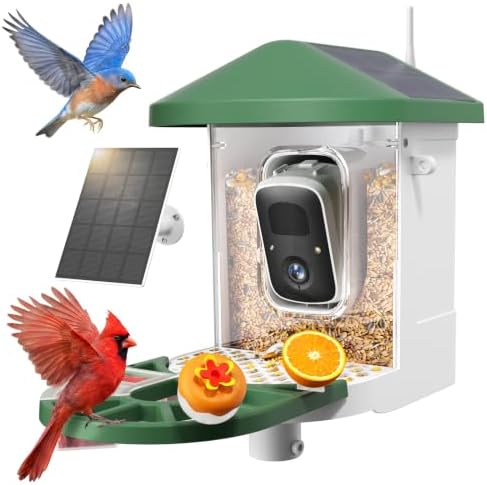
The default pick is a solar roofed feeder with built in AI identification, a chamber that holds enough seed for several days, and a pole plus strap mount in the box. It suits an open yard with reasonable wifi, and it is the version most people should buy rather than starting cheap and replacing it.
When Your Yard Is Shaded Most of the Day
Under a canopy the solar roof contributes very little, so the useful design is one with a larger battery and a detachable camera module, or one that accepts a separate panel you can site in a sunnier spot on a cable. Battery capacity matters more here than resolution does.

If You Want the Footage Stored Locally
Some models take a microSD card and record to it, so clips exist on the feeder whether or not you pay for cloud storage. That is the setup to look for if you dislike subscriptions on principle. Check the listing for the card size it accepts and whether identification is separate from storage, since those are two different features.

Where Squirrels Already Own the Yard
A camera feeder is a plastic box full of seed on a pole, and squirrels treat it accordingly. Metal housings, a chewed resistant lid and a baffle underneath are the practical answer. Nothing here is squirrel proof in the absolute sense, and our guide to doing both jobs at once explains what the two goals cost each other.

For Hummingbirds Instead of Seed Eaters
Hummingbird camera feeders are a separate product, because the camera has to focus at a much shorter distance and cope with a bird that hovers rather than perches. They are worth having as a second feeder rather than a replacement, and the details are in our hummingbird camera feeder guide.

Comparing the Common Setups
Most camera feeders fall into four broad shapes. The differences below are the ones you notice weekly, rather than the spec numbers that get compared once and then forgotten.
| Setup | Power in practice | What it shows best | Best suited to |
|---|---|---|---|
| Solar roof, hopper style | Keeps up in open sun, struggles in shade | Perching seed eaters at close range | The default first camera feeder |
| Battery only, detachable camera | Predictable, needs a charge routine | Same framing, fewer power surprises | Shaded yards and covered porches |
| Window mounted with camera | Usually charged indoors, easy access | Very close portraits through glass | Balconies, apartments, small yards |
| Hummingbird camera feeder | Small panel, small battery | Hovering birds at very short focus | A second feeder in nectar season |
Where the Pictures Go Wrong
Three things ruin footage more often than the camera does. Backlight, because a feeder with the morning sun behind it gives you a silhouette. Motion, because a feeder swinging on a cord makes every clip drift. And clutter, because a busy fence two feet behind the perch turns a portrait into a mess.
All three are fixed by placement rather than by buying a better sensor. Face the lens away from the low sun, mount on something rigid rather than hanging on a chain, and leave open background behind the perch. That is most of the difference between the pictures in the listing and the pictures on your phone, and it is covered step by step in where to mount a camera feeder.
What the Identification Really Does
The species label is a guess made from the image. It is confident on common, well marked yard birds and much less so on sparrows, immature birds and anything half hidden by a wing. Check anything surprising against a reference such as Cornell Lab of Ornithology’s All About Birds.
What This Does Not Change About Feeding Birds
A camera does not change the maintenance. The chamber still needs to stay dry, the seed still clumps after rain, and the feeder still needs cleaning on the same schedule as any other. If anything a camera makes you more aware of it, because you can see the wet seed and the birds refusing it.
Feeders concentrate birds, and both Cornell Lab of Ornithology and Audubon advise regular cleaning and taking a feeder down if you see sick birds using it. If an outbreak is being reported in your area, check what your state wildlife agency is advising right now. Our feeder cleaning guide covers the routine.
Frequently Asked Questions
Is a bird feeder with camera worth it? If you enjoy seeing birds close up and you have a spot with decent wifi and some sun, yes. If your yard birds mostly feed on the ground, or your router barely reaches the garden, you will get less out of it than the marketing suggests.
Do camera bird feeders need a subscription? It depends on the brand and the model. Some include identification permanently, some include it only during a trial, and some charge for longer clip history rather than for identification. Check the plan described on the listing before you buy, because the split changes.
How far can a camera feeder be from the router? Far enough varies with your house and your router, and no brand can promise a distance. Most run on the 2.4GHz band, which reaches better through walls than 5GHz. Our guide to range and dropouts covers how to test the spot before you mount anything.
Does the camera scare the birds? Not for long. New feeders of any kind take days to be found and accepted, and the camera itself is silent. Chickadees and titmice usually arrive first, and the rest of the yard follows once they see the feeder being used.
Which brand should I start with? Start by choosing the plan and the power setup you want, then pick a brand that matches. Our brand comparison puts the main names side by side, and Birdfy against Bird Buddy covers the two most asked about.
The Bottom Line
Buy a camera feeder on power, plan and mounting, and treat resolution as a tiebreaker. A solar roof with a detachable, chargeable camera covers most yards, a local storage model suits anyone allergic to subscriptions, and placement does more for your footage than any sensor upgrade. Read next: camera feeders with no subscription fee for the models built around local storage, and how the identification actually works if you want to know what the app is really doing.