Last updated: August 21, 2026
Most people buy the feeder first and the pole last, which is backwards. The pole decides where the feeder can stand, whether a baffle will fit it, whether it stays upright in wet ground, and whether the squirrels ever get a climb at all. A good feeder on a bad pole is a squirrel dispenser.
There is also a quiet compatibility trap. Baffles are sold for specific pole diameters, and a pole that comes in at an odd size leaves you with a baffle that either will not thread on or slides down loose. This guide covers height, diameter, ground anchoring and the clearance rule that makes the whole thing work.
This article contains affiliate links. If you buy through them, we may earn a commission at no extra cost to you. Learn more.
Quick Answer
What should you look for in a bird feeder pole?
- A smooth surface with no couplers or brackets low down, because every joint is a foothold.
- A diameter that matches a stovepipe baffle, which is the number to check before anything else.
- Enough height that the feeder hangs above your eye line and the baffle sits well off the ground.
- A ground anchor with real bite, an auger or a wide stake, rather than a thin spike that leans after rain.
Bottom line: buy the pole for the baffle and the clearance, not for the number of arms it has.
What the Pole Is Actually For
A pole does three jobs. It puts the feeder where you can see it from indoors, it holds the feeder at a height birds are comfortable using, and it forms the only approach route a squirrel has once the feeder is far enough from everything else. The third job is the one that decides your seed bill.
That is why smoothness beats decoration. A pole with a twist finish, a joint collar or a low mounted arm gives a climbing animal somewhere to brace, and a baffle above that point simply gets bypassed from below.
The Ten Foot Rule
Clearance is the single most useful number in backyard bird feeding. Cornell Lab of Ornithology notes that squirrels can jump to feeders placed less than ten feet from a tree or a building, and Audubon frames the same rule as siting the feeder at least eight to ten feet from trees, buildings, fences and anything else a squirrel can launch from.
Applied properly, that means walking the yard with a tape measure rather than eyeballing it from the kitchen. The fence rail, the shed roof, the low limb of the maple and the arbor all count, and so does the neighbor’s deck if it backs onto your line.
Height Above the Ground
The other half of the rule is vertical. A baffle needs to sit high enough that a squirrel cannot leap over it from the grass, which Audubon puts at roughly four to five feet, and the feeder needs to sit above the baffle with enough pole left to be useful. That is what pushes a serviceable feeder pole well past head height rather than the waist high garden stakes sold in the same aisle.
Diameter and Why Baffles Do Not Fit
Baffles are made for a small set of pole diameters, and a pole outside that set is a pole you cannot protect. Before you order anything, find the diameter in the listing and then find a baffle that lists the same figure as its inner opening. Doing it in that order saves a return.
Sectional poles introduce a second problem. Each joint is either a coupler that sticks out or a threaded section that steps in, and both give a squirrel purchase. If you buy a sectional pole, keep the joints high, above where the baffle sits, so the climb is stopped before the animal reaches one.
Feeder Poles by Situation
Best All Around Choice for an Open Lawn
A single smooth steel pole with an auger style ground anchor is the default for a spot you can measure out properly. One piece of tube, no low brackets, one hook at the top, and a stovepipe baffle underneath. It looks plain, and it is the setup that quietly ends the squirrel problem.

When You Want Several Feeders in One Spot
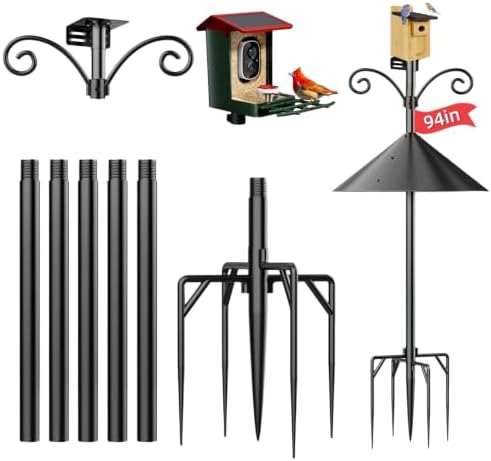
A multi arm pole system lets you run a tube, a suet cage and a nectar feeder off the same station, which concentrates the traffic where you can see it. The thing to check is that the arms sit high, above the baffle line, and that they are long enough that a squirrel on the pole cannot reach the feeders sideways.

For a Deck, a Balcony or a Rental
Where you cannot put anything in the ground, a clamp mounted pole on a railing is the option. Be honest about what it can achieve: a railing is itself a launch point, so this is a setup for watching birds up close rather than for defeating squirrels. A caged feeder makes more sense here than a baffle.

For Soft, Wet or Sandy Ground
A thin spike in soft ground leans within a season, and a leaning pole puts the feeder back within reach of the fence. Look for a wide auger, a cross plate or a long stake that spreads the load, and set the pole with the ground damp rather than baked hard so it beds properly.

When the Baffle Comes First
If you already own a baffle you like, buy the pole to match its opening rather than the other way around. Poles listed with a specific diameter and a matching baffle in the same range save the guesswork, and our baffle guide explains which shape suits which approach route.
Comparing Pole Types
The trade is always between how many feeders you can hang and how easy the pole is to defend. Every extra arm is another place for an animal to stand.
| Type | Feeders it carries | Baffle friendliness | Best suited to |
|---|---|---|---|
| Single smooth pole | One, sometimes two | Highest, nothing in the way | An open lawn spot you can measure |
| Multi arm station | Three to five | Good if the arms sit high | Watching several feeder types at once |
| Shepherd hook | One or two | Depends on height and gauge | Borders, soft ground, quick setup |
| Deck clamp mount | One or two | Low, the rail is a launch point | Balconies, rentals, close viewing |
Getting It Into the Ground and Keeping It There
An auger anchor screws in and grips far better than a spike pushed in with a boot, and the difference shows up the first time a wet week is followed by a squirrel hanging off one arm. Set the pole plumb, then check it again a fortnight later once the ground has settled around it.
In heavy clay, soak the spot first rather than hammering the pole in dry, which is how thin tube gets bent at the top. In sandy or made ground, a wider anchor or a plate does more than extra depth does.
Winter and the Frozen Ground Problem
Poles set in late fall are easier to install than poles set in January, and a pole you plan to move each season is better on a stake plate than screwed into ground that is going to freeze around it. If you are setting up for winter feeding, get it in before the first hard frost.
Frequently Asked Questions
How tall should a bird feeder pole be? Tall enough that the baffle sits around four to five feet up, as Audubon suggests, with the feeder above that and still reachable for refilling. In practice that means a pole well above head height rather than a short garden stake.
How far from a tree should the pole go? Cornell Lab notes squirrels reach feeders sited less than ten feet from a tree or a building, and Audubon suggests eight to ten feet of clearance from trees, fences and structures. Measure to the nearest branch tip, not to the trunk.
What pole diameter fits a squirrel baffle? Baffles list an inner diameter and the pole has to match it. Check the baffle listing and the pole listing against each other before ordering, because a mismatch is the most common reason a baffle gets returned.
Is a pole better than hanging from a tree branch? For squirrel resistance, yes, by a wide margin. A branch gives the animal an approach from above that no pole baffle can stop. If the feeder has to hang from a tree, use a dome baffle above it or a caged feeder.
Do I need a separate baffle if the feeder is squirrel resistant? Usually yes. A weight activated feeder stops the animal at the ports but does nothing to stop it sitting on the roof all day and deterring birds. The two work together, as covered in our squirrel resistant feeder guide.
Can I use one pole for several feeders? Yes, and a multi arm station is a pleasant way to watch a yard. Keep the arms high and long, and remember that a busy station spills more seed underneath, which is the issue our rodent guide deals with.
The Bottom Line
Choose the pole for its diameter, its smoothness and its anchor, then site it by the tape measure rather than by the view. Eight to ten feet of clearance, a baffle four to five feet up, no couplers below that line, and an anchor that will not lean. Everything else, including how many arms it has, is preference. Read next: our baffle shapes guide and the comparison of buying a feeder with a pole included or separately.